Date and Time
Location
Abstract
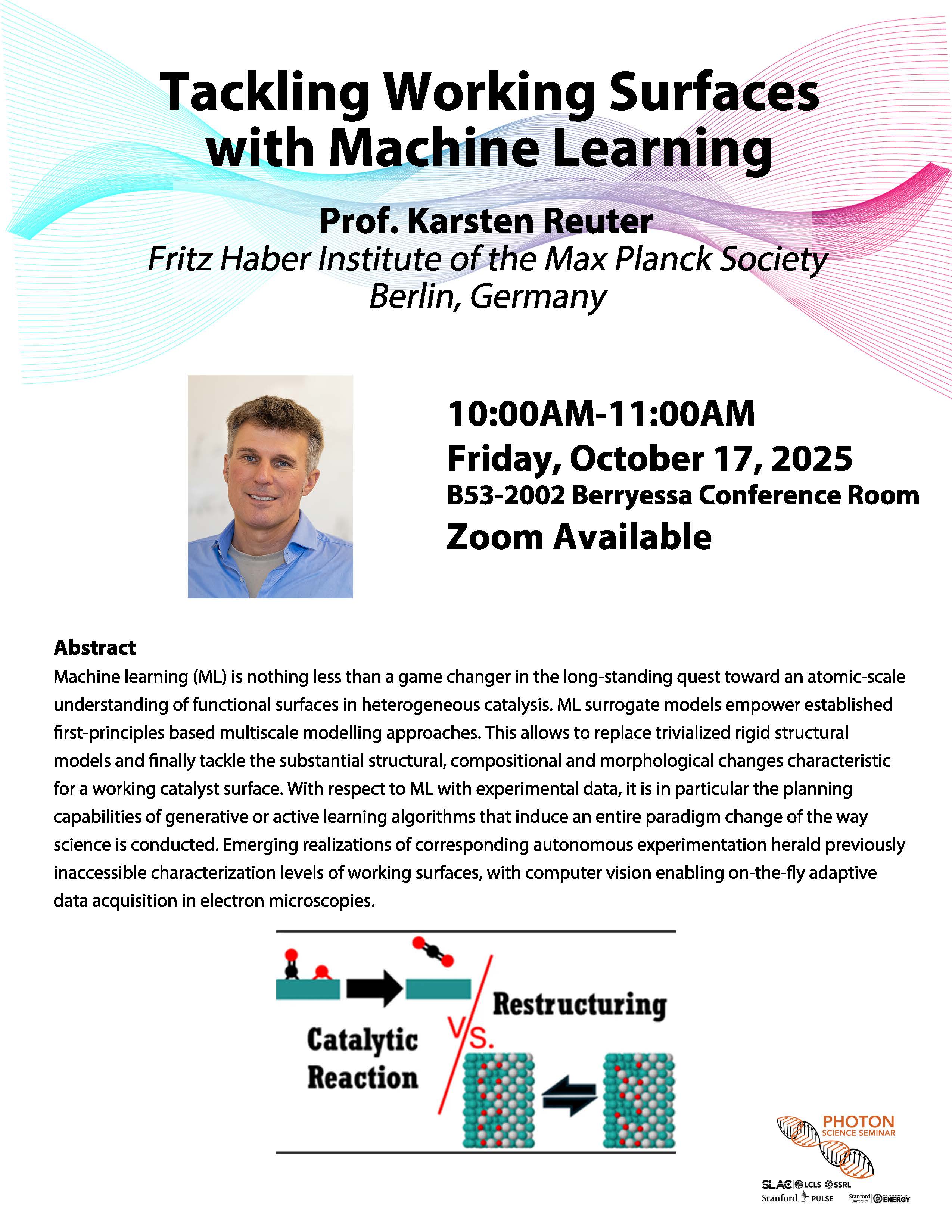
Machine learning (ML) is nothing less than a game changer in the long-standing quest toward an atomic-scale understanding of functional surfaces in heterogeneous catalysis. ML surrogate models empower established first-principles based multiscale modelling approaches. This allows to replace trivialized rigid structural models and finally tackle the substantial structural, compositional and morphological changes characteristic for a working catalyst surface. With respect to ML with experimental data, it is in particular the planning capabilities of generative or active learning algorithms that induce an entire paradigm change of the way science is conducted. Emerging realizations of corresponding autonomous experimentation herald previously inaccessible characterization levels of working surfaces, with computer vision enabling on-the-fly adaptive data acquisition in electron microscopies.
Links
Poster