Date and Time
Location
Abstract
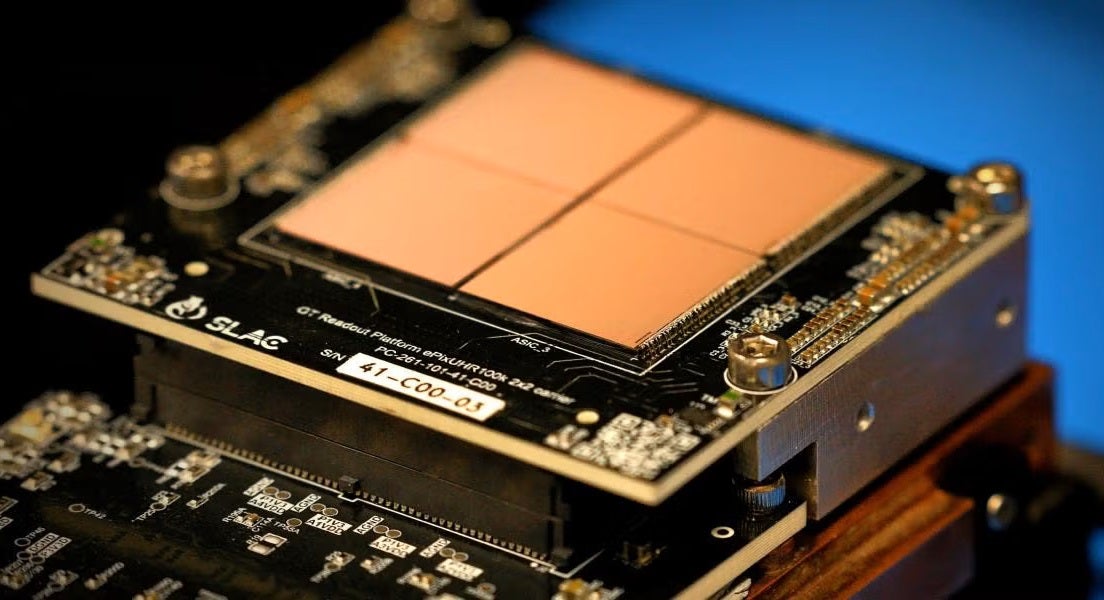
Modern X-ray light sources such as LCLS-II are entering a regime of unprecedented brightness and repetition rate, producing data streams that challenge existing detector architectures in bandwidth, latency, and energy consumption. This talk presents ongoing R&D on high-rate detectors for LCLS-II-HE, including the ePixUHR and SparkPix families, highlighting advances in speed, system integration, and sparsified readout. Building on these developments, a paradigm shift toward intelligent detectors is outlined, where information extraction moves to the sensor edge through on-chip processing, compression, and adaptive control. In this context, the AUREIS development framework is introduced, along with the Morpheus Detector platform, as a path toward self-optimizing, energy-efficient detector systems.
Bio
Angelo Dragone is an Associate Professor of Photon Science and Electrical Engineering (by courtesy) at Stanford University and a member of the SLAC faculty, where he leads detector and microelectronics research within the Technology Innovation Directorate. His team focuses on the design of ultrafast X-ray detectors and mixed-signal ASIC architectures for high-rate scientific instrumentation, with applications in photon science and particle physics. His research interests include ultrafast X-ray detector architectures, intelligent sensing systems, and edge-processing platforms for real-time information extraction, with the goal of enabling energy-efficient, adaptive, and autonomous data-driven instrumentation.
Links
Poster